Battle royale games have dominated the mobile gaming industry for years, and two titles consistently stand at the top of that competition: PUBG Mobile and Free Fire. Both games have massive global player bases, dedicated esports scenes, and passionate communities, yet they offer very different experiences despite sharing the same core genre.
For new players trying to decide which game to invest their time in, or veteran players simply curious how the two titles stack up against each other, this comparison breaks down everything from gameplay mechanics to graphics, competitive scenes, and device requirements.
Game Overview
PUBG Mobile is the mobile adaptation of PlayerUnknown’s Battlegrounds, one of the games credited with popularizing the battle royale genre on PC and consoles before making its way to smartphones. It emphasizes realism, larger maps, and longer match durations.
Free Fire, on the other hand, was designed specifically for mobile devices from the ground up. It focuses on shorter, faster-paced matches with smaller maps, making it more accessible for players who want quick, action-packed sessions rather than long, drawn-out survival matches.
Map Size and Match Length
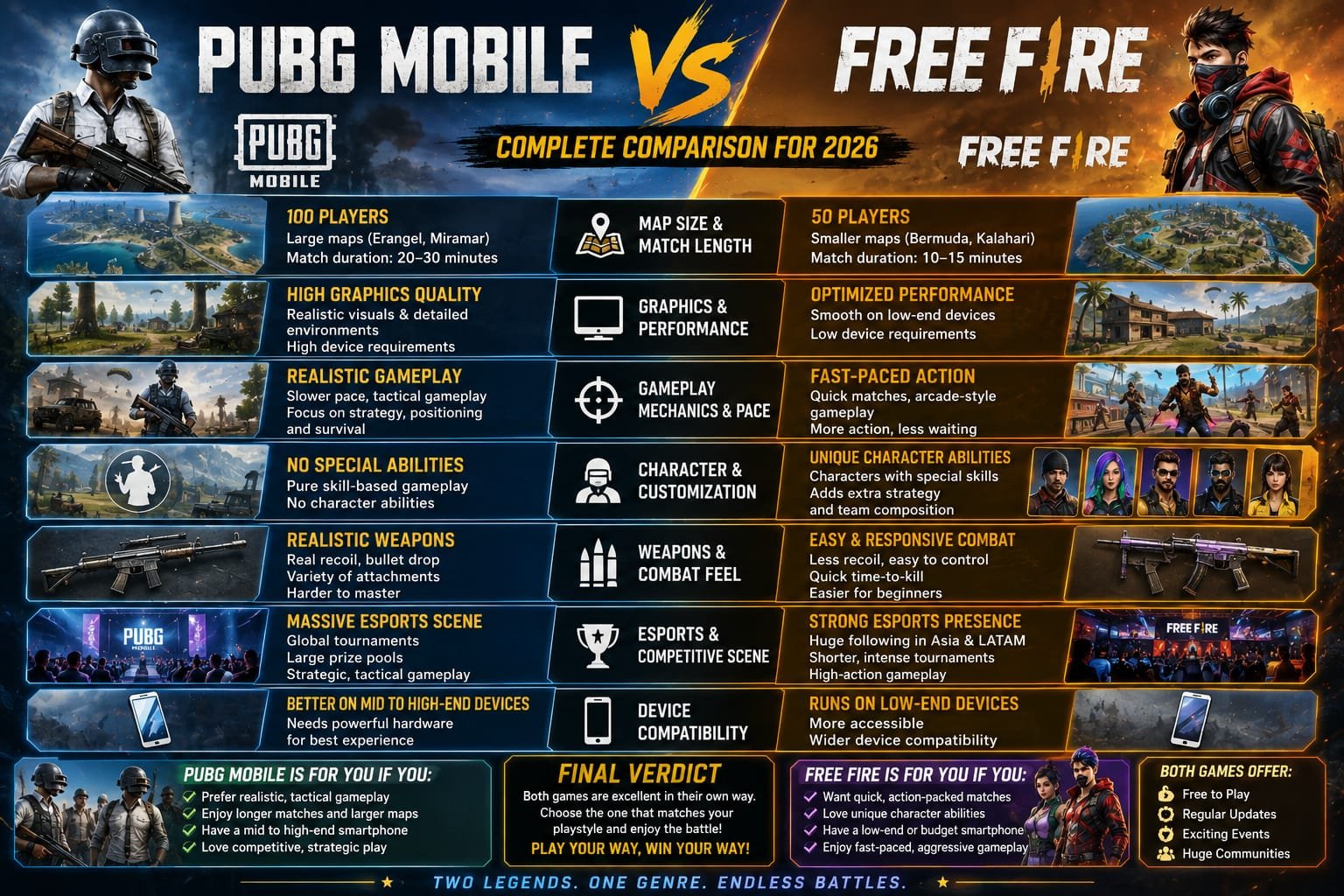
One of the most noticeable differences between the two games is match length and map size. PUBG Mobile matches typically last between 20 to 30 minutes and take place on large maps that can support up to 100 players. This creates a slower-paced early game, with more time spent looting, driving vehicles, and positioning strategically before major fights break out.
Free Fire matches, by comparison, are much shorter, usually wrapping up within 10 to 15 minutes on smaller maps designed for 50 players. This makes Free Fire a better choice for players who want to squeeze in a quick match during a short break, while PUBG Mobile suits players who have more time to commit to a longer, more methodical playstyle.
Graphics and Performance Requirements
PUBG Mobile is generally more graphically demanding, offering more detailed environments, realistic lighting, and higher-fidelity character models. This makes it visually impressive on high-end devices but can be challenging to run smoothly on older or budget smartphones.
Free Fire was built with accessibility in mind, using lighter graphics that run smoothly even on lower-end devices. This has made it especially popular in regions where budget smartphones are more common, since players don’t need top-tier hardware to enjoy a smooth gaming experience.
Gameplay Mechanics and Pace
The gameplay pace between the two titles differs significantly. PUBG Mobile leans toward realism, with mechanics like bullet drop, vehicle physics, and a wide variety of weapon attachments that require players to understand ballistics to some degree. Positioning and patience are heavily rewarded, and reckless aggressive play is often punished.
Free Fire takes a more arcade-style approach. Characters have unique special abilities that can be activated during matches, adding a layer of strategy beyond just gunfights. The faster time-to-kill and smaller map encourage more aggressive, action-oriented gameplay, which appeals to players who prefer constant engagement over prolonged survival strategy.
Character Abilities and Customization
This is one of the biggest gameplay differentiators. Free Fire’s character system allows players to select from a roster of characters, each offering unique passive or active abilities, such as increased healing speed, extra loot capacity, or combat boosts. This adds a strategic layer where team composition matters beyond just weapon choice.
PUBG Mobile does not have this character ability system, staying closer to the original PC game’s realistic approach where success depends purely on positioning, aim, and decision-making rather than special skills. Players who enjoy strategic depth through character abilities tend to prefer Free Fire, while those who want a purer, skill-based shooter experience often lean toward PUBG Mobile.
Weapon Variety and Combat Feel
Both games offer an extensive arsenal of weapons, including assault rifles, sniper rifles, shotguns, and submachine guns, but the combat feel differs. PUBG Mobile’s weapons behave more realistically, with noticeable recoil patterns and bullet drop over distance, requiring players to compensate for these factors during long-range engagements.
Free Fire’s weapons are more straightforward, with less emphasis on realistic ballistics and more focus on quick, responsive combat. This makes Free Fire slightly easier to pick up for beginners, while PUBG Mobile has a steeper learning curve that rewards players willing to master its more nuanced combat system.
Esports and Competitive Scene
Both titles have thriving esports ecosystems, but they differ in scale and structure. PUBG Mobile has one of the largest esports scenes in mobile gaming, with major international tournaments offering substantial prize pools and global recognition. Its slower, more tactical gameplay translates well into a spectator-friendly competitive format.
Free Fire also boasts a massive esports presence, particularly strong in regions like Southeast Asia and Latin America, with tournaments that showcase its fast-paced, high-action gameplay. The shorter match times make Free Fire tournaments more condensed and intense to watch, which appeals to audiences who prefer quick, high-stakes action over extended strategic play.
Device Compatibility
For players with budget or older smartphones, Free Fire is generally the more accessible option due to its lower hardware requirements. It runs smoothly on a wider range of devices without significant lag or performance issues.
PUBG Mobile, while it does offer performance settings to accommodate lower-end devices, generally requires a more capable smartphone to run at its best. Players with flagship or mid-range devices will get the most out of PUBG Mobile’s visual fidelity and smooth performance.
Which Game Should You Choose?
Choosing between PUBG Mobile and Free Fire ultimately comes down to personal preference and playstyle. If you enjoy realistic gunplay, longer strategic matches, and don’t mind investing more time per session, PUBG Mobile is likely the better fit. Its larger maps and slower pace reward patience and tactical thinking.
If you prefer quick, action-packed matches that fit into shorter breaks, along with unique character abilities that add strategic variety, Free Fire is the stronger choice. Its accessibility on lower-end devices also makes it a great option for players without high-end smartphones.
Many players in the mobile gaming community actually enjoy both games, switching between them depending on their mood or available time. There’s no need to pick just one title if both genres and playstyles appeal to you.
Monetization and In-Game Purchases
Both games use free-to-play models supported by cosmetic purchases, battle passes, and character or skin unlocks. Neither game requires spending money to remain competitive, as core gameplay elements like weapons and gear are earned through normal match progression rather than purchased.
PUBG Mobile’s cosmetic system includes character outfits, weapon skins, and vehicle skins, often tied to seasonal battle passes. Free Fire follows a similar structure, with character skins, weapon skins, and pet customizations available through its battle pass and in-game store.
Final Verdict
Both PUBG Mobile and Free Fire have earned their place as leading battle royale titles in the mobile gaming space, and each excels in different areas. PUBG Mobile offers a deeper, more realistic experience for players who enjoy tactical gameplay and don’t mind longer matches, while Free Fire delivers fast, accessible, action-packed sessions ideal for players with limited time or lower-end devices.
Rather than viewing this as a strict competition, it’s more accurate to see these games as catering to different player preferences within the same genre. Trying both and seeing which one resonates with your personal playstyle is the best way to decide which battle royale title deserves a permanent spot on your device in 2026.
About the Author